Find Your Job
  Start Hiring


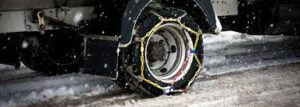
The weather is getting colder every day across the whole USA, and some parts of it even have inches of snow. That means it’s time to remind you about chain laws in the states that you regularly run.
Alaska
You cannot use tire chains south of 60° latitude from April 15 to September 30.
South of 60° latitude: No chains allowed from April 15 to September 30.
On Sterling Highway: No chains allowed from May 1 to September 15.
If you want to use chains in those areas during those dates, you must get a permit from the Department of Administration.
California
California does not require trucks to carry chains during any specified time period. When the weather is bad, a standard tractor-trailer needs at least eight chains to follow the rules.
During the winter months, there will be traction chain controls in the mountain areas. When these are established, you will see signs posted along the highway. These signs will include one of the following:
- Chains, traction devices, or snow tires are required on the drive axle of all vehicles.
- Chains or traction devices are required on all vehicles, no exceptions.
Colorado
From September 1 to May 31, all trucks on I-70 must have enough chains. This rule applies between mile marker 259 near Golden and mile marker 133 in Dotsero. If you are stopped without chains on the truck, the fine is 50 dollars plus a 16 dollar surcharge.
- If you ignore the chain law, the fine is 500 dollars plus a 78 dollar surcharge.
- If you ignore the law and block the highway, the fine goes up to 1,000 dollars plus a 156 dollar surcharge.
Connecticut
Chains are allowed in bad weather from November 15 to April 30, but they must not damage the road surface.
Delaware
You are allowed to use chains on highways from October 15 to April 15. State officials can restrict travel on highways during emergency situations.
Georgia
At any time, the Georgia Department of Transportation may close or limit access to certain highways during bad weather. If this happens, signs will be placed to inform drivers that chains are required in order to proceed further. (For commercial trucks, you must put the chains on the outer drive tires.)
Idaho
Idaho DOT can determine that driving over Lookout Pass, Fourth of July Pass on I-90, and Lolo Pass on Highway 12 is unsafe. If they make that call, you must put chains on at least one tire on each drive axle, plus one axle at or near the rear.
Maine
Vehicles cannot have tires with metal studs, wires, spikes, or other metal parts sticking out from the tread. This rule is in effect from May 1 to October 1. Other vehicles that use tire chains are allowed when safety requires it. This is during snow, ice, or other conditions that can make highways slippery.
Massachusetts
Massachusetts prohibits the use of studded tires and chains between May 1 and November 1 without a permit. Tire chains are allowed for safety during snow, ice, or bad weather that makes roads slippery.
Michigan
The use of chains is allowed for safety when snow, ice, or other condition are present. If chains are used, they must not come in direct contact with the roads surface.
You cannot drive with metal or carbide studded tires from April 1 to November 1. You can use chains if they are needed for safety during snow, ice, or other slick conditions.
Montana
You are allowed to use chains on highways from October 1 through May 1.
If the Montana Department of Transportation determines that highways are too dangerous for travel, they may establish the following recommendations on traction devices:
- Chains or other approved traction devices are recommended for drive wheels
- Chains or other approved traction devices required for drive wheels
- Chains required for driver wheels
Nebraska
You can use tire chains for safety when there is snow, ice, or other slippery conditions. This is allowed from November 1 to April 1.
Nevada
You cannot drive on a snowy or icy road without chains, traction devices, or snow tires if signs say they are needed. This rule applies to all vehicles, even emergency vehicles.
If a highway is marked with a sign requiring the use of traction devices, vehicles must be equipped with:
- Traction devices, tire chains or snow tires if it has a gross weight or combined gross weight of 10,000 pounds or less.
- Tire chains if it has a gross weight or combined gross weight of more than 10,000 pounds.
North Dakota
North Dakota allows metal studs that stick out up to 1/16 inch from October 15 to April 15. You can use tire chains if they are needed for safety during snow, ice, or other slick conditions.
Oregon
Oregon’s rules apply to every highway in the state. Signs will tell you when you must carry chains and when you must use them. You need to have six chains with you to follow the law. You can use chains whenever they are needed for safety in snow, ice, or other slick conditions
South Dakota
South Dakota DOT can limit travel on certain roads, and signs will tell you when the rules are in place. You can use tire chains if they are needed for safety in snow, ice, or other slick conditions.
Tennessee
You can use tire chains for safety when there is snow, ice, or other slippery conditions. This is allowed from October 1 to April 15.
Utah
If Utah DOT closes a highway due to winter weather, no one can use it from October 1 to April 30. This also applies when conditions are bad, unless they follow the chain rules.
- For commercial trucks with four or more drive wheels (not buses), the driver must put chains on at least four of the drive tires.
Vermont
Vermont’s traffic committee decides when chains are required. You can use chains anytime if they are needed for safety in snow, ice, or other slick conditions.
If a truck with a semitrailer or a trailer has a tandem-drive axle, it must have chains:
• On two tires on each side of the main drive axle. (If both drive axles are powered, then one tire on each side of each axle).
• On one tire on the truck’s front axle and one tire on one of the trailer’s rear axles.
Washington
Any commercial vehicle over 10,000 lbs. Gross vehicle weight rating should carry chains from November 1 to April 1 when driving on one of the following routes:
- Blewett Pass
SR-97 between MP 145 and Milepost 185
- Chinook Pass
SR-410 Enumclaw (MP 25) to SR-12 (MP 342)
- Cle Elum to Teanaway
SR-970 Cle Elum (MP 0) to Teanaway (MP 10)
- Gibbons Creek to Intersection of Cliffs Rd.
SR-14 Gibbons Creek (MP 18) to Intersection of Cliffs Rd. (MP 108)
- Mt. Baker Highway (Ellensburg to Selah)
SR-542 (MP22) to (MP 57) I-82 from Ellensburg (MP 3) to Selah (MP 26)
- Newhalem to Winthrop
SR-20 Newhalem (MP 120) to Winthrop (MP 192)
- Omak to Nespelem
SR-155 Omak (MP 79) to Nespelem (MP 45)
- Satus Pass
SR-97 Columbia River (MP 00) to Toppenish (MP 59)
- Sherman Pass
SR-20 Tonasket (MP 262) to Kettle Falls (MP 342)
- Snoqualmie Pass
I-90 North Bend (MP 32) and Ellensburg (MP 101)
- Stevens Pass
SR-2 Dryden (MP 108) to Index (MP 36)
- White Pass
SR-12 Packwood (MP 135) to Naches (MP 187)
Wyoming
When the chain law is active because of snow, ice, or bad conditions, only vehicles with proper snow tires or chains may use the highway. There are two levels:
Level 1: If conditions are dangerous, only vehicles with chains, good snow tires, or all-wheel drive can travel.
Level 2: If conditions are extremely hazardous, only vehicles with chains or all-wheel-drive vehicles with mud and snow or all-weather tires may travel.
For commercial trucks, you must put chains on at least two drive tires, and they must be on opposite ends of the same drive axle.
(If a driver breaks the rule, the fine can be up to 250 dollars).
(If the violation causes the highway to shut down, the fine can go up to 750 dollars.)
All these states share the same rules
Minnesota; Mississippi; Missouri; Virginia; Texas; West Virginia; Wisconsin; Pennsylvania; Rhode Island; South Carolina; New Hampshire; New Jersey; New Mexico; New York; North Carolina; Ohio; Oklahoma; Arizona; Arkansas; Illinois; Indiana; Iowa; Kansas; Kentucky; Louisiana; Maryland; Alabama;
The use of chains is allowed when it’s required for safety during snow, ice, or other conditions that might cause slippery roads.